
A Greadingz story
The Mountain Learned His Name

In San Isidro, Mateo learns the quiet language of animals and a word that stops a goat at the fence—while a mountain waits to learn his name.
Introduction
The school bell was the worst sound in San Isidro.
It struck the air without warning, and Mateo felt each clang in his teeth. On the first day of class, he covered his ears. A boy behind him laughed. The next morning, Mateo covered them before the bell rang, and the boy laughed again.
After that, the others watched for the things Mateo did before he knew they were watching: the way he repeated a question under his breath while he found its answer, the way he lined his pencils along the desk, the way he stepped outside when the classroom grew too loud.
The doctor in town had called it autism. Tía Nini had listened carefully, then taken Mateo home and made him a place at her table. She did not ask him to explain every silence. When he was ready to speak, she listened.
At the ranch, there was less need to explain. The animals made their meanings plain in other ways. The old dog Ceniza turned her head when she heard a truck on the road. The mule pinned back her ears when the cinch was too tight. The hens grew restless before rain.
Mateo watched them. He learned their habits as he learned the paths between the house and the well: slowly, by returning to them every day.
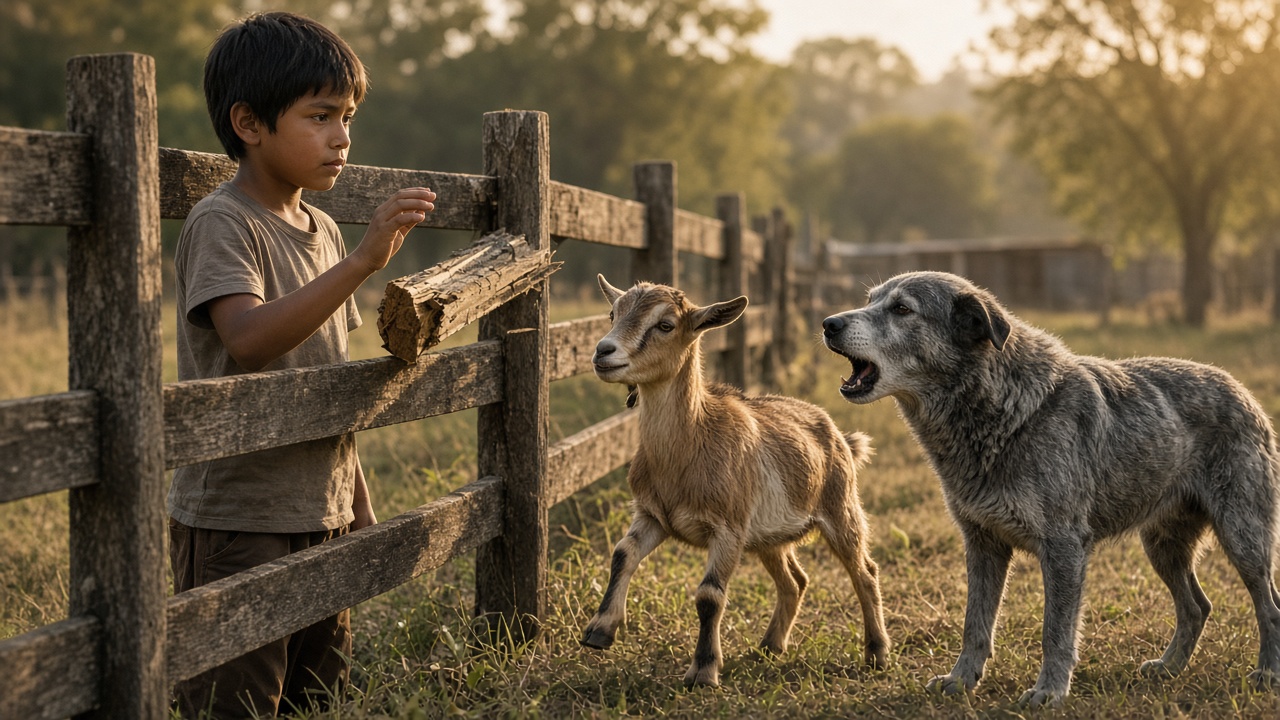
One afternoon, a young goat slipped through a broken place in the fence. Ceniza bounded after it, barking. The goat bolted toward the road.
Mateo stood very still.
“Quieto,” he said.
Ceniza stopped.
The goat stopped, too. It stood with one front hoof lifted, its ears turned toward Mateo. For a moment, the ranch seemed to be holding its breath with them.
Then Tía Nini called from the kitchen, and the spell—or whatever it was—broke. Ceniza trotted back. The goat wandered toward the fence. Mateo went to mend it.
At supper, Tía Nini asked how the fence had broken.
Mateo told her about the loose board, the goat, and Ceniza.
He did not mention the word he had used.
Chapter One — The First Night
Mateo remembered the dogs first.
They barked at the dark with a fury he had never heard from them before. He sat up in bed, listening. The house was quiet except for his mother moving in the kitchen and the dogs beyond the walls.
Then his father spoke.
“Stay with your mother.”
Mateo did not understand why. His mother came to him and held his shoulders. She smelled of soap and the onions she had been cutting for supper. Somewhere outside, a truck stopped.
The men’s voices came through the house, low and hurried. Mateo could not make out the words. His mother drew him close. He pressed his cheek against her blouse and counted the tiny blue flowers sewn along its edge.
There were two loud sounds. Then another.
His mother held him tighter. Her hands covered his ears, but the sounds had already reached him. Afterward, she did not answer when he said her name.
Mateo stayed beside her until morning.
His parents were dead before the sun rose over the hills.
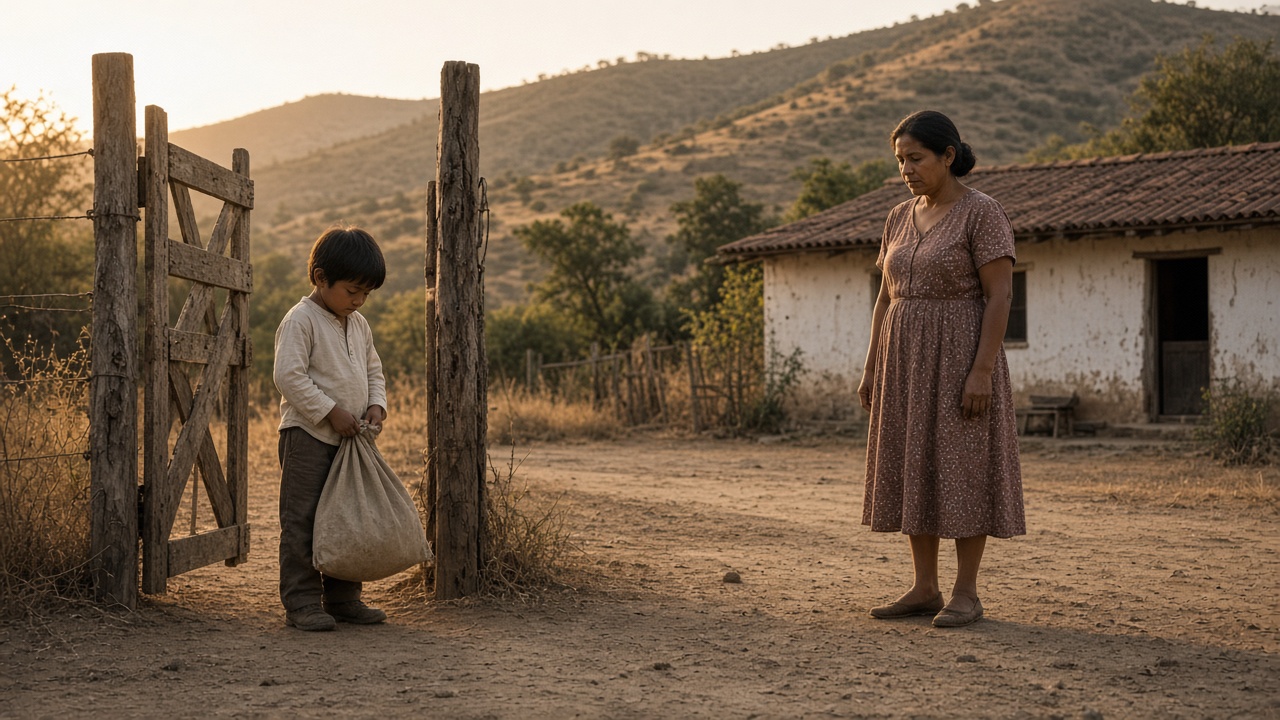
A woman from the village found him in the house. She spoke gently and took his small canvas bag from beneath the bed. Mateo carried it himself when she brought him to Nina’s ranch.
The men who had come in the night belonged to the cartel. The woman did not say that aloud on the road. Neither did Nina when they reached her gate. Some names were best kept behind the teeth.
Nina had been waiting since dawn.
She had known her sister would not come. She had known there was a boy, of course, but knowing and knowing were different things. Mateo had been a baby the last time she held him. The rest of him had reached her in a handful of letters and one photograph, where he sat on his mother’s lap with a solemn face.
Now he stood in front of Nina, five years old, holding a bag that looked too heavy for him.
She was grateful he was alive. The thought came with such force that she had to look away for a moment.
“Mateo,” she said.
He watched the dust on her shoes.
“I’m Nina. Your aunt.”
The village woman touched his shoulder. Mateo stepped away from her hand.
Nina saw it and stopped herself from reaching for him. “You can come in when you’re ready.”
The woman gave Nina a tired look. “He hasn’t said much.”
Nina nodded. She wanted to ask what had happened in the house, what the men had done, what Mateo had seen. But the woman’s face had closed around those answers.
“Thank you for bringing him,” Nina said.
The woman left without coming inside.
Mateo stayed by the gate. Nina left it open and went a few steps toward the house. After a long while, she heard his shoes scuff the earth behind her.
She did not turn around until they were both inside.
The kitchen was cool. A blue cup sat on the table beside a plate of tortillas. Nina poured water and set the cup down carefully. The bottom touched the wood with a small click.
Mateo flinched.
Nina looked at the cup. Then at him.
“I’m sorry,” she said, though she did not know what she had done.
She lifted the cup and set it down more softly. Mateo reached for it. He drank a little, then placed it back in the same spot.
Nina warmed a tortilla. She put it on a plate by itself, without beans or eggs. She had no way of knowing whether that was what he liked. It only seemed easier than guessing at several things at once.
“Do you want this?”
Mateo did not answer.
She waited, then sat across from him. He watched the steam thin above the plate. After a while, he tore off a small piece and ate it.
Nina tried not to show her relief.
The house had a ticking clock over the pantry door. She had stopped hearing it years ago. Mateo kept glancing toward it. At last she took the clock down and laid it facedown on the shelf.
The room grew quiet.
He ate another piece of tortilla.
Afterward, Nina showed him the small room at the back of the house. It had a narrow bed and a wooden chest. The window looked out toward the yard, where a line of washed clothes moved in the breeze.
“You can sleep here,” she said. “Your things can go in the chest.”
Mateo set his bag on the floor. He did not open it.
Nina opened it for him. There were two shirts, a pair of shorts, a comb, and a red button wrapped in a scrap of cloth. She placed each thing on the bed.
Mateo picked up the button.
Nina almost asked if it had belonged to his mother. Instead, she said, “You can keep it.”
He closed his hand around it.
That evening, she made soup. Mateo ate a little bread and drank water from the blue cup. When the church bell rang, his hands flew to his ears. His eyes squeezed shut.
Nina stood beside the table, unsure whether to touch him.
The bell sounded again.
She waited until it stopped. Mateo lowered his hands. His face was still, but his breathing came quickly.
“It’s over,” she said.
He watched her mouth.
Nina repeated the words, more slowly. “It’s over.”
Mateo turned toward the window.
At bedtime, Nina left the door open a hand’s width. She put the red button on the table beside his bed. He had carried it all afternoon, and she thought he might want it near.
She went to her own room and sat on the edge of the mattress. The village had gone quiet. Beyond the yard, one of the dogs barked once and fell silent.
For a long time, Nina listened for Mateo to cry.
He did not.
Just before sleep took her, she heard him say one word, very softly.
“Over.”
She did not know whether he was answering her or speaking to the dark.
To be continued.
Enjoyed this piece? Support the library · Get Black Dog free